


If your property has high groundwater, limited soil depth, or you simply want a greener way to handle household wastewater, an ATU is worth a closer look. These advanced systems use oxygen to break down waste more completely than a traditional septic tank, producing cleaner effluent that can be safely dispersed even in difficult terrain.
An ATU can be a smart investment when conventional septic designs will not meet local code—or when you’d like the peace of mind that comes with a higher level of treatment and lower environmental impact. Just remember that the extra performance comes with extra responsibility: routine aerator maintenance, periodic inspections, and electricity to power the system are non‑negotiable. If you’re prepared for that commitment, an ATU could give your property a reliable, eco‑friendly wastewater solution for decades to come.
ATU systems may be right for you if:
- Your property has poor soil conditions, high water table, or limited space
- You need to reduce environmental impact (especially nitrogen reduction)
- You want treated water that can potentially be reused for irrigation
- You’re willing to manage higher upfront costs and more frequent maintenance
- Your area has strict environmental regulations for septic systems
When it comes to home wastewater management, most people don’t have much experience with the options available. This is especially true for ATU (Aerobic Treatment Unit) septic systems, which offer a different approach to handling household waste.
ATU systems use oxygen to break down organic matter in wastewater, mimicking the processes used in municipal treatment plants but on a smaller scale. Unlike traditional septic systems that rely on anaerobic (without oxygen) bacteria, ATUs introduce air to create an oxygen-rich environment where aerobic bacteria thrive and break down waste more efficiently.
This technology offers several advantages over conventional septic systems, particularly for properties with challenging site conditions. ATUs can reduce the required drainfield size by up to 50%, making them ideal for smaller lots. They’re also suitable for locations with high water tables or poor soil quality where traditional systems might fail.
That said, ATUs aren’t for everyone. They typically cost more upfront, require more frequent maintenance (every 1-3 years vs. 3-5 years for conventional systems), and need electricity to operate the air pumps. Before making a decision, it’s important to understand your specific property needs and local regulations.
What Is an ATU Septic System and How Does It Work?
Think of an Aerobic Treatment Unit (ATU) as your very own mini wastewater treatment plant, right in your backyard! Unlike traditional septic systems that work in the absence of oxygen, ATUs actually thrive on it.
The name tells you exactly what makes these systems special – “aerobic” means “with oxygen.” Your ATU system actively pumps air into the wastewater using blowers or diffusers, creating the perfect environment for oxygen-loving bacteria to do their cleanup work.
“ATUs function like small-scale municipal treatment plants right in your backyard,” as we often explain to our West Coast Sanitation customers. “They transform your wastewater through multiple treatment stages, producing cleaner effluent that’s less harmful to the environment.”
Here’s how the magic happens:
First, your wastewater enters a pretreatment tank (sometimes called a trash tank), where the initial separation happens naturally – solids sink to the bottom while grease floats to the top.
Next comes the heart of the system – the aeration chamber. This is where oxygen is introduced through diffusers or air pumps, creating a bubbling, oxygen-rich environment where aerobic bacteria thrive. These hungry microorganisms break down organic matter much more efficiently than their oxygen-deprived cousins in traditional septic tanks.
After aeration, the water flows into a settling chamber (clarifier) where any remaining solids can peacefully settle out of the water.
Many ATU systems also include a disinfection stage using either chlorine or ultraviolet light to knock out any remaining pathogens before the water moves on.
Finally, the treated effluent is pumped to a drainfield or, in some cases, can be used for subsurface irrigation (though regulations on this vary by location).
What really sets ATUs apart is their impressive ability to reduce nitrogen levels in wastewater by 50-90%, significantly lowering the risk of groundwater contamination compared to conventional systems. This makes them particularly valuable if you live near sensitive watersheds or in areas with high groundwater tables.
More info about How a Septic Tank Works
The Science Behind Aerobic Treatment
The real wonder of ATU systems lies in the biological processes happening when oxygen meets wastewater. It’s a bit like supercharging nature’s cleaning crew!
Aerobic bacteria need oxygen to survive and multiply. When they get plenty of dissolved oxygen (usually maintained at 2-6 mg/L), these microorganisms become incredibly efficient at consuming organic waste. In fact, they work up to 20 times faster than the anaerobic bacteria found in conventional septic systems.
This speedier process creates mainly carbon dioxide and water rather than the methane and hydrogen sulfide that cause those unpleasant septic odors we all want to avoid. That’s right – ATUs typically smell much less than traditional systems!
The treatment process doesn’t just work faster; it works better too. Properly functioning ATUs can reduce fecal coliform bacteria by up to 99.9%, compared to 90-95% for conventional systems, meeting strict EPA standards for wastewater treatment.
Many advanced ATU systems create a complex ecosystem within the treatment chamber. Some include fixed-film media – specially designed surfaces where beneficial bacteria can grow in abundance. Think of these as luxury high-rise apartments for bacteria, providing more surface area for these helpful microbes to colonize and do their work.
“The biological processes in an ATU are remarkably similar to what happens in nature when streams self-purify,” we often tell our customers at West Coast Sanitation. “We’re just creating optimal conditions for nature’s cleanup crew to do their work more efficiently.”
Is an ATU septic system right for you? If you value cleaner wastewater treatment and have concerns about environmental impact, it might be the perfect solution for your property.
ATU vs Conventional Septic: Components, Stages & Performance
When comparing ATU systems to conventional septic systems, you’ll notice differences not just in how they work, but in their physical components and overall performance. Think of an ATU as the overachiever of the septic world – it simply does more with your wastewater!
A conventional septic system is pretty straightforward – it has a tank and a drainfield. Simple, but somewhat limited. An ATU system, on the other hand, includes several specialized components working together like a well-orchestrated team.
The journey of your wastewater through an ATU begins in the pretreatment or trash tank, which works similarly to a conventional septic tank, separating solids and greases from the liquid. But here’s where things get interesting – the partially treated wastewater then flows into an aeration chamber, the star player of the ATU system. This chamber contains diffusers that bubble oxygen through the wastewater, creating a paradise for hungry aerobic bacteria.
After getting its oxygen treatment, the wastewater moves to the clarifier, where remaining solids settle out before the increasingly clear liquid moves forward. Many systems include a pump tank that holds the treated effluent until it’s ready for final disposal. Overseeing this entire operation is a control panel with timers and alarms that monitor system function – something you won’t find on a conventional system.
“The difference in performance is like comparing a modern hybrid car to an old gas-guzzler,” explains our team at West Coast Sanitation, Inc. “Both will get you there, but one does it much more efficiently with less environmental impact.”
When it comes to performance, conventional systems only treat about 30-50% of wastewater pollutants in the tank, leaving the soil to handle the rest. ATUs, however, perform approximately 90% of treatment before the wastewater even reaches the soil. This superior treatment means ATUs produce cleaner effluent with fewer pathogens and nutrients, especially nitrogen.
This efficiency translates to real-world benefits: ATUs can reduce your drainfield size by up to 50%, making them perfect for smaller lots. They’re also champions in challenging soil conditions where conventional systems might throw in the towel.
More info about Basic Components of a Septic System
Key Stages of Treatment
The magic of an ATU happens in five distinct stages, each playing a crucial role in changing your household waste into clean effluent.
The journey begins with pretreatment, where your wastewater enters the system and undergoes initial separation. Heavy solids sink to form sludge, while lighter materials like grease float to the top creating a scum layer – similar to what happens in a conventional septic tank.
Next comes the aeration stage – this is where ATUs truly shine! Air pumped through diffusers creates thousands of tiny bubbles that distribute oxygen throughout the wastewater. The aerobic bacteria absolutely love this oxygen-rich environment and go to work breaking down organic matter much faster than their anaerobic cousins could ever dream of doing.
After this oxygen party, the wastewater flows into the settling or clarification stage. Here, any remaining suspended solids can peacefully settle out in a chamber designed to prevent turbulence. Think of it as the quiet cool-down after an intense workout.
Many ATU systems include a disinfection stage using either chlorination or ultraviolet light to eliminate remaining pathogens. If your system uses chlorine, it typically includes a contact chamber where chlorine tablets dissolve into the effluent. UV systems, meanwhile, pass the effluent through a chamber containing UV lamps that zap any lingering bacteria.
Finally, the treated effluent reaches the final dispersal stage, where it’s either pumped or flows by gravity to its final destination – typically a reduced-size drainfield or, in some cases, a drip irrigation system that can water landscaping (where local regulations permit).
Each stage builds on the previous one, resulting in effluent that’s dramatically cleaner than what comes from a conventional septic tank. This is especially important if you live near sensitive water bodies or have a high water table on your property.
Component Spotlight: Blowers, Media & Timers
Let’s peek under the hood at the components that make an ATU tick – these are the unsung heroes of your wastewater treatment system!
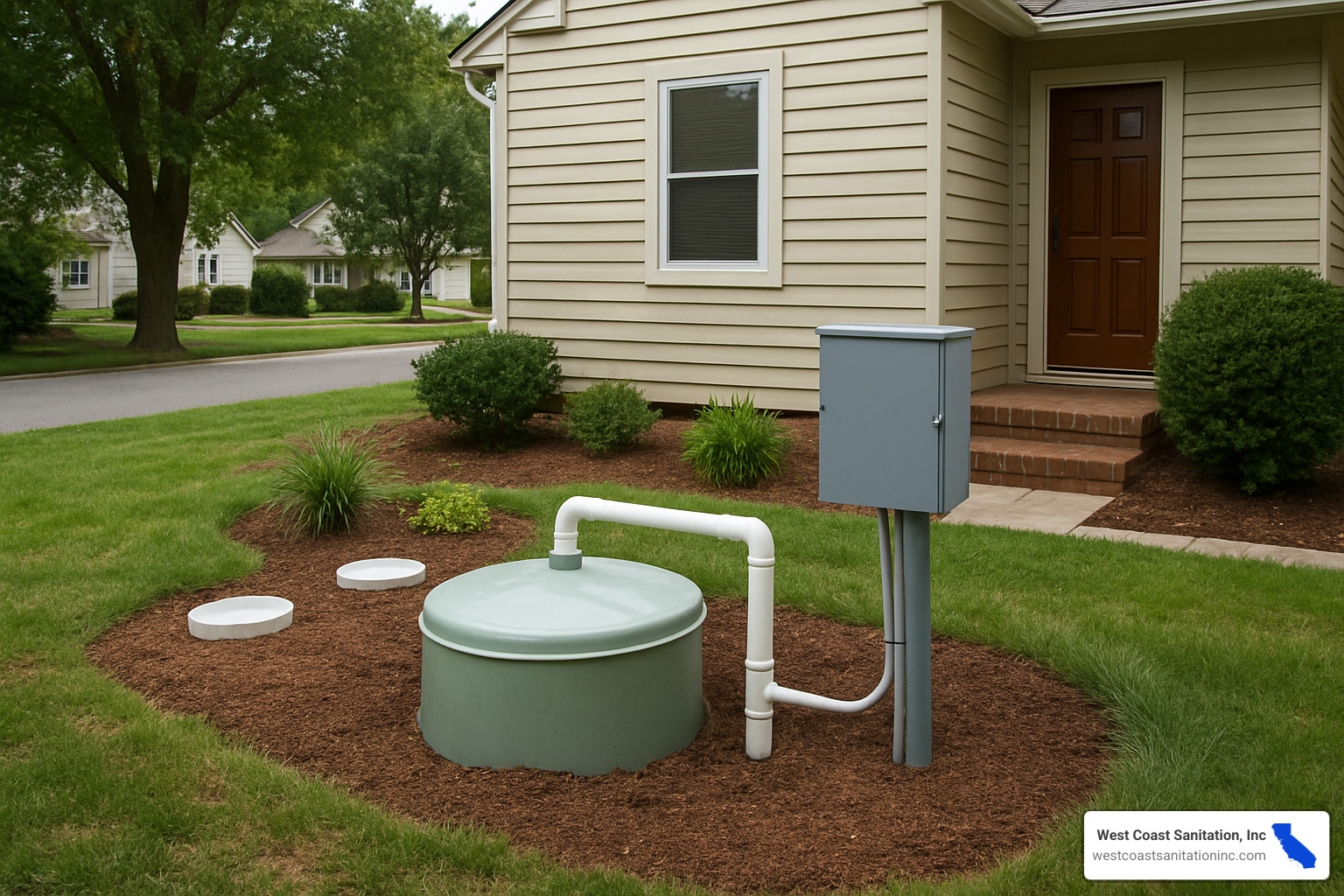
Blowers and compressors are the true workhorses of your ATU. These dedicated little machines run around the clock, pumping life-giving oxygen into your system’s aeration chamber. Most residential ATUs use small, efficient rotary vane or linear air compressors housed in a protective case either above ground or in a sealed compartment of the tank.
Think of the blower as the heart of the ATU system.. It keeps everything circulating and healthy. These compressors typically use about 50-75 watts continuously – roughly the same as keeping a light bulb on – which translates to approximately $5-15 per month on your electricity bill.
Many advanced ATU systems incorporate fixed-film media within the aeration chamber. These synthetic materials provide surfaces for beneficial bacteria to call home, creating a “fixed film” of microorganisms. Imagine thousands of tiny apartment buildings for bacteria! Common media materials include plastic rings, honeycombed plastic sheets, or specially designed textile materials. The beauty of fixed-film systems is their stability – they handle irregular use patterns beautifully, making them perfect for vacation homes.
Your ATU’s control systems and alarms are the brains of the operation. Modern ATUs incorporate sophisticated controls that regulate aeration cycles, monitor oxygen levels, detect system malfunctions, manage disinfection processes, and control effluent pumping schedules. Most include visual and audible alarms that alert you to potential problems like power failures or high water conditions. Some advanced systems even offer remote monitoring capabilities that can send alerts to your phone or email – pretty smart for a septic system!
Rather than running full-blast all the time, some ATU systems use timers and sensors to create intermittent aeration cycles, saving energy while maintaining effective treatment. Sensors may monitor dissolved oxygen levels, water levels, flow rates, and even effluent quality in more sophisticated systems.
The complexity of these components highlights a key difference between ATUs and conventional septic systems: ATUs are active systems requiring electricity and regular maintenance, while conventional systems are passive, mostly relying on gravity and natural processes. It’s a trade-off – more components mean more effective treatment but also more maintenance to keep everything running smoothly.
More info about Aerobic vs Anaerobic Septic Systems
Pros, Cons & Cost Breakdown
When you’re trying to decide if an ATU septic system is right for you, it’s important to look at the full picture – both the sunny side and the rainy day scenarios, along with what it means for your wallet over time.
Advantages of ATU Systems:
Let’s start with the good news. ATU systems offer some impressive benefits that make them worth considering for many homeowners. The treatment quality is exceptional – these systems can reduce nitrogen levels by 50-90% compared to conventional systems, which is a big win for the environment. They also do a much better job at reducing harmful pathogens.
Space-savers by design, ATUs can shrink your required drainfield size by up to half, making them perfect if you’re working with a smaller lot or have limited suitable soil on your property. This space-saving feature alone can be a deciding factor for many homeowners in the Inland Empire.
For those of you with challenging property conditions, ATUs really shine. They’re problem-solvers for difficult sites with high water tables, poor soil conditions, or shallow bedrock – places where conventional systems might throw in the towel.
“Many of our customers are surprised to learn they can actually reuse some of that water,” shares one of our technicians at West Coast Sanitation. In many areas, the high-quality effluent can be used for subsurface irrigation, potentially cutting your landscape water usage by about 25%.
Another pleasant surprise? Less odor. The aerobic process creates fewer of those nose-wrinkling compounds than traditional anaerobic systems. Your backyard barbecues will thank you!
Disadvantages of ATU Systems:
Now for the reality check. ATUs aren’t without their drawbacks. The upfront cost is higher – typically 2-3 times more than conventional septic systems. This is often the biggest hurdle for homeowners considering the switch.
These systems also depend on electricity to keep those blowers and pumps running. During a power outage, your system’s treatment capacity will be compromised unless you have a backup power source.
Maintenance is more frequent and involved with ATUs. While conventional systems might need professional attention every 3-5 years, ATUs require inspection and service 2-4 times annually. They also typically need pumping every 1-3 years instead of every 3-5 years for traditional systems.
The mechanical complexity means more components that could potentially need repair or replacement. And in many areas, service contracts aren’t optional – they’re required by local regulations.
Some homeowners are also concerned about the noise and appearance factors. While modern blowers are relatively quiet, they do make some sound, and the above-ground components might be visible depending on your installation.
More info about Aerobic vs Anaerobic Septic Systems
Financial Snapshot & ROI
Let’s talk dollars and sense. Understanding what an ATU system will cost you – both now and down the road – is crucial for making a smart decision.
Initial installation costs for conventional septic systems typically range from $3,000-$10,000, while ATU systems run higher at $10,000-$20,000. Here in the Inland Empire region of Southern California where we operate, ATU installations usually fall in the middle to upper end of this range due to our specific soil conditions and local regulations.
The ongoing costs add up too. You’ll need to budget for electricity ($5-15 monthly), an annual maintenance contract ($200-500), pumping every 1-3 years ($300-600), occasional component replacement like blowers every 3-5 years ($300-700), and possibly disinfection materials like chlorine tablets ($100-200 annually).
But there are potential savings to consider as well. If your effluent is approved for landscape irrigation, you might save $150-400 annually on water bills. ATUs typically last 15-20 years when properly maintained, similar to or slightly longer than conventional systems. And in certain areas, they may even increase your property value by making previously undevelopable lots usable.
“We often tell our clients that an ATU is an investment in both their property and the environment,” says our team at West Coast Sanitation, Inc. “While the upfront costs are higher, the system can pay dividends through reliability, versatility, and environmental protection.”
Potential Drawbacks & Mitigations
Every system has its challenges, but most can be managed with the right approach.
Electricity dependence is perhaps the most obvious vulnerability of ATU systems. During power outages, the treatment process can be compromised. To address this, consider installing a backup power source such as a generator with automatic transfer switch or a battery backup system. Some newer ATU models even include built-in backup power options.
Mechanical failures are another concern with any system that has moving parts. Blowers, pumps, and electrical components can malfunction over time. The best defense is regular professional maintenance and choosing systems with quality components and good warranties. Many modern ATUs include alarm systems that alert you to problems before they become serious – a real lifesaver!
Many jurisdictions require ongoing maintenance contracts for ATU systems, which adds to the cost. Rather than viewing this as just another bill, think of it as an investment in system longevity. A well-maintained ATU will function better and last longer. At West Coast Sanitation, Inc, we offer maintenance plans that can be bundled with installation to help reduce overall costs.
ATUs can be more sensitive to household chemicals than conventional systems. The aerobic bacteria doing the heavy lifting in your ATU can be disrupted by antibacterial products, harsh chemicals, and even medications. Being mindful about what goes down your drains will help keep your system running smoothly.
For vacation homes or properties with irregular usage, ATUs present unique challenges since the bacterial colonies need consistent feeding. If this describes your situation, look for ATUs specifically designed for irregular use patterns, or consider systems with programmable controls that can adjust operation based on occupancy.
Finally, noise concerns can be an issue for some homeowners. While modern ATU blowers are generally quiet, they can be further insulated or housed in sound-dampening enclosures. Proper placement away from outdoor living areas and bedrooms can also minimize any noise impact.
By understanding these potential challenges and taking proactive steps to address them, you can enjoy all the benefits of an ATU system while keeping headaches to a minimum.
Is An ATU Septic System Right For You?
Determining whether an ATU septic system is right for you involves more than just comparing technical specifications. It’s about finding the perfect match between your property’s unique characteristics and your personal priorities as a homeowner.
“When we sit down with families across the Inland Empire, we’re not just talking about tanks and pipes,” shares our team at West Coast Sanitation, Inc. “We’re helping them make decisions that will impact their property value, environmental footprint, and daily life for decades to come.”
Let’s walk through the key factors that might make an ATU the perfect solution for your home:
Site-specific challenges often make ATUs the clear winner. If your property has stubborn clay soil that barely drains, or rocky terrain that’s a nightmare to excavate, an ATU might be your saving grace. While conventional systems depend heavily on soil to complete the treatment process, ATUs handle most of the heavy lifting inside the tank itself.
Dealing with a high water table? You’re not alone. Many homeowners in Southern California’s seasonal wetland areas face this challenge. ATUs produce significantly cleaner effluent that poses much less risk to groundwater—protecting both your drinking water and the broader ecosystem.
Small lot owners, we hear you! That cozy quarter-acre might not leave much room for a traditional drainfield. An ATU’s ability to function with up to 50% less drainfield space can be the difference between building your dream home or walking away from a property.
For those blessed with homes near our beautiful lakes, streams, or coastal areas, ATUs offer peace of mind. Their superior treatment capabilities mean you can enjoy waterfront living while being a responsible steward of these precious resources.
Beyond property considerations, your personal values matter too. If environmental sustainability ranks high on your priority list, an ATU’s superior treatment capabilities align perfectly with this commitment. Water-conscious homeowners appreciate the potential to reuse treated effluent for subsurface irrigation (where local codes permit), turning “waste” water into a resource.
Planning for the future? If you’re dreaming of adding that in-law suite or growing your family, an ATU’s treatment capacity and efficiency might better accommodate your long-term vision than a conventional system that’s already working at maximum capacity.
Yes, ATUs require a bigger upfront investment, but they often prove more economical in challenging site conditions where conventional systems might fail prematurely. Think of it as paying for quality and peace of mind.
Is An ATU Septic System Right For You? — Property & Site Checklist
To help you evaluate whether your property conditions point toward an ATU solution, consider these key indicators:
Soil conditions speak volumes. Does your property feature sandy soil that drains too quickly, or dense clay that barely percolates? Both extremes can be problematic for conventional systems but manageable with an ATU.
Groundwater proximity is critical. If seasonal high water tables rise to within 3-4 feet of the surface, an ATU provides significantly better protection against contamination.
Available space constraints often tip the scales. Limited room for a drainfield? ATUs can work within tighter boundaries while maintaining effective treatment.
Proximity to water bodies raises the stakes. Properties near natural water features benefit from the cleaner effluent that ATUs produce, protecting these sensitive ecosystems.
Shallow bedrock or restrictive soil layers can make conventional drainfield installation nearly impossible. ATUs offer compatible alternative dispersal methods that work within these limitations.
Challenging topography like steep slopes that complicate traditional drainfield layouts? ATUs offer more flexible installation options.
Local regulations sometimes make the decision for you. Many jurisdictions now require advanced treatment systems in environmentally sensitive zones.
“Throughout Riverside and San Bernardino counties, we’ve installed hundreds of successful ATU systems,” notes our team. “Particularly in the hillier areas of Temecula, Murrieta, and the foothills around Redlands and Yucaipa where soil conditions present real challenges to conventional systems.”
Is An ATU Septic System Right For You? — Decision Flowchart
Making this important decision doesn’t have to be overwhelming. Consider these questions in sequence:
Do strict environmental regulations govern your property? If yes, an ATU may already be required or strongly recommended by local authorities. If not, keep exploring your options.
Are you dealing with challenging soil conditions? Rocky terrain, clay, sand, or poor percolation rates all suggest an ATU would be beneficial. Good soil with proper drainage? You might have more flexibility.
Is your seasonal high water table close to the surface? ATUs provide superior groundwater protection when that water table rises to within 4 feet of ground level.
Is your available drainfield space limited? ATUs need significantly less area, making them perfect for smaller lots or properties with limited suitable soil areas.
Are you comfortable with the investment-versus-benefit equation? While ATUs cost more upfront, they offer better performance and environmental protection. Your budget and priorities matter in this decision.
Can you commit to regular maintenance? ATUs require more frequent professional attention. If this seems burdensome, a conventional system might better match your lifestyle.
Would landscape irrigation benefits appeal to you? In many areas, ATU effluent can be used for subsurface irrigation, creating potential water savings.
“Every property tells its own story,” our team often explains. “That’s why we offer free, no-obligation consultations throughout the Inland Empire. We’ll help you steer these questions based on your specific situation rather than pushing a one-size-fits-all solution.”
Frequently Asked Questions about ATU Systems
How long does an ATU last?
With proper care, you can expect your ATU system to serve you faithfully for 15-20 years—comparable to conventional septic systems. The tanks themselves (typically made of concrete or fiberglass) can last for decades, though mechanical components like blowers and pumps may need replacement every 3-5 years.
“We’ve seen well-maintained ATUs in the Inland Empire region still going strong after 20+ years,” our team shares. “The key is consistent maintenance and being mindful of what goes down your drains.”
Several factors influence your system’s lifespan, including installation quality, maintenance consistency, household water usage patterns, and even the climate conditions in your area. Investing in quality components from reputable manufacturers also makes a significant difference in longevity.
Can ATU effluent be used for lawn irrigation?
One of the most exciting benefits of an ATU system is the potential to reuse that clean effluent for subsurface landscape irrigation. This feature is especially valuable in water-conscious Southern California.
“In parts of the Inland Empire where water conservation is critical, the ability to reuse treated wastewater for landscape irrigation can significantly reduce your water bill,” explains our team. “We’ve installed several systems in the Temecula and Murrieta areas that incorporate landscape irrigation components.”
However, there are important guidelines to follow. Most areas only permit subsurface irrigation with drip lines buried 6-12 inches below the surface—not spray irrigation. Regulations typically prohibit using treated effluent on food crops, limiting use to ornamental plants, lawns, and non-edible landscaping. Your local health department can provide specific guidelines for your area, and additional disinfection may be required before reuse.
What are the ongoing energy costs?
Yes, ATU systems do require electricity to operate, but the cost is typically less than many homeowners expect. The primary energy consumer is the aeration blower, which uses about 50-75 watts continuously—similar to keeping a light bulb on.
For most homes, this translates to approximately $5-15 per month in electricity costs, or $60-180 annually. If your system includes additional components like effluent pumps or UV disinfection, these may add slightly to your energy consumption, though they typically operate intermittently rather than continuously.
“Many of our customers are pleasantly surprised by how little their ATU impacts their electric bill,” our team notes. “We can also recommend energy-efficient models or solar power options for those looking to minimize operational costs while maintaining effective treatment.”
Call West Coast Sanitation Today!
The journey to finding the right septic system can feel overwhelming, but understanding your options is half the battle. ATUs represent a remarkable step forward in how we handle wastewater at home. They’re not just tanks in the ground—they’re miniature treatment plants that work harder so your property doesn’t have to.
For many homeowners throughout the Inland Empire, ATUs have been game-changers. They’ve made building possible on lots that would have been undevelopable with conventional systems. They’ve provided peace of mind near sensitive watersheds. They’ve even helped some homeowners reduce their water bills through irrigation reuse.
If you’re still wondering whether an ATU septic system is right for you, we’d love to help you explore your options. As a family-owned business deeply rooted in the Inland Empire community, we bring both technical expertise and a neighbor’s care to every project. Our free consultations provide personalized guidance based on your property’s unique characteristics and your family’s specific needs.
The best septic system isn’t necessarily the most advanced or the most basic—it’s the one that’s properly designed for your site, expertly installed, and regularly maintained throughout its life. Whether that’s an ATU or another solution, we’re here to help you make that determination with confidence.
More info about residential septic system installation